What Is pfSense and How to Use It: VLAN and Firewall Guide
Learn what pfSense does, how to install it, and how to build a four-VLAN home network with explicit firewall, DNS, mDNS, and VPN policy.
If you are asking what is pfsense and how to use it, pfSense is firewall/router software between an ISP and a network. It provides routing, stateful filtering, IPv4 NAT, DHCP, DNS, and VPNs, but does not replace a managed switch or AP.
What pfSense is and the goal
Netgate describes pfSense as a customized FreeBSD firewall/router distribution. Community Edition (CE) is the open-source project; pfSense Plus is Netgate’s product with additional features.
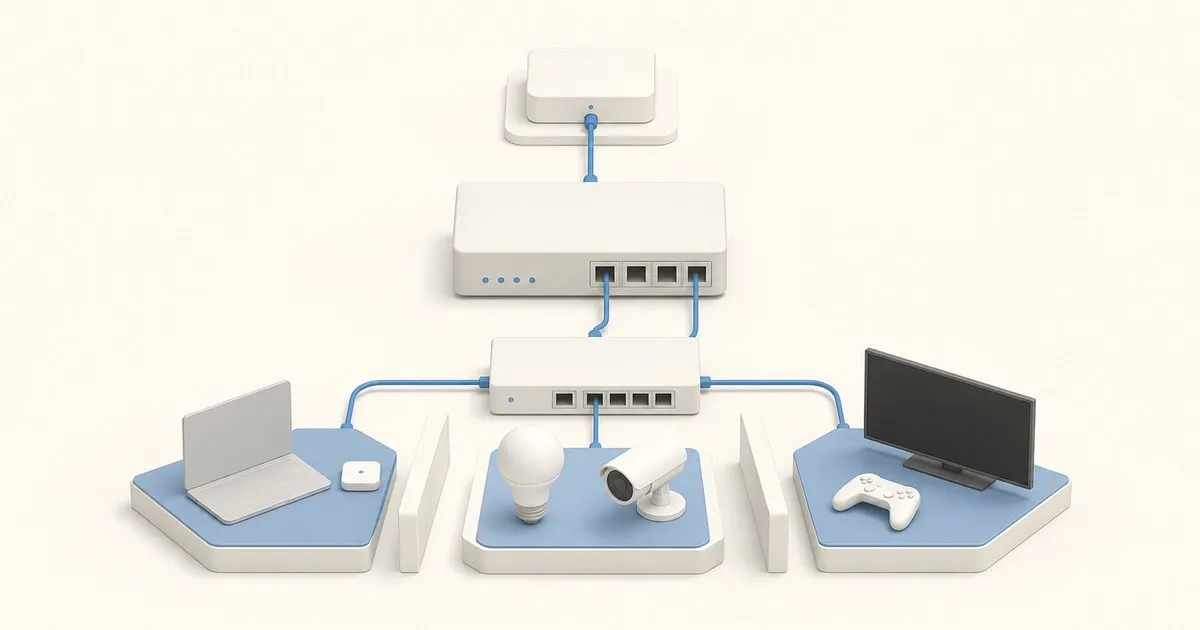
The goal is segmentation: trusted, IoT, guest, and management devices occupy separate broadcast domains. pfSense routes between them with deny-by-default policy; a switch carries VLANs and APs map SSIDs. Remote administration uses a VPN, not a WAN port forward to TCP 443. UPnP stays off unless a documented requirement justifies it.
Install and make the first configuration
Use a Netgate appliance or compatible two-NIC hardware. The Netgate Installer requires Internet connectivity. Defaults include LAN 192.168.1.1/24, HTTPS on TCP 443, LAN DHCP, outbound IPv4 NAT, and blocked unsolicited WAN traffic.
Connect a laptop to LAN, open https://192.168.1.1, change the admin password, and confirm WAN. Keep console or temporary untagged-LAN access; do not convert the active management link mid-session.
Under Interfaces > Assignments > VLANs, create each tag, assign and enable its interface, set its static address/prefix, then enable DHCPv4. Leave Upstream Gateway unset on inside VLANs. Netgate’s VLAN procedure confirms that a tag alone does not create DHCP or firewall policy.
After VLAN 10 works from port 13, disable legacy-LAN DHCP and pass rules, then unassign parent igc0 or set IPv4/IPv6 to None. If VLAN 10 becomes logical LAN, disable anti-lockout only after its explicit admin rule works. Confirm untagged 192.168.1.1/24 no longer answers.
Topology
Example, not required: ISP ONT/CPE -> Netgate 6100 WAN1 (ix3, 1 Gbps) -> LAN1 (igc0, 2.5 Gbps) -> USW-Pro-Max-24-PoE port 17 -> U6-Enterprise on port 24.
- Switch port
17: trunk to unaddressed parentigc0; VLANs10,20,30, and40tagged; unused VLAN999native/PVID and unrouted. - Switch port
24: trunk to the U6-Enterprise; VLAN10native/PVID for AP management; SSIDs tagged as trusted20, IoT30, and guest40. - Ports
1-8: access VLAN20, PVID20; ports9-12: access VLAN30, PVID30; ports13-14: access VLAN10for admin and controller. Reserve10.10.10.2,.3, and.10for switch, AP, and UniFi Network controller.
Set the switch as RSTP root and enable BPDU guard on endpoint access ports, not trunks.
VLAN plan
| VLAN ID | Name | CIDR | DHCP range | Gateway | Inter-VLAN policy |
|---|---|---|---|---|---|
| 10 | management | 10.10.10.0/24 | 10.10.10.100-149 | 10.10.10.1 | Admin alias may manage infrastructure; otherwise deny |
| 20 | trusted | 10.20.0.0/24 | 10.20.0.100-199 | 10.20.0.1 | Deny other VLANs except named services such as a printer |
| 30 | iot | 10.30.0.0/24 | 10.30.0.100-239 | 10.30.0.1 | Deny internal networks; allow required Internet ports |
| 40 | guest | 10.40.0.0/24 | 10.40.0.100-239 | 10.40.0.1 | Deny firewall management and all internal networks |
IPv6 needs an ISP PD prefix of /62 or larger so each VLAN gets a /64. Enable RA everywhere; SLAAC and/or DHCPv6 assign addresses, but RA supplies the gateway. Put local/VPN prefixes in INTERNAL_V6, mirror policy, and preserve NDP plus ICMPv6 Packet Too Big. NAT is not a firewall.
Firewall rules in apply order
Rules are stateful, ingress, and first-match; floating and group rules precede interface rules. Define Network alias INTERNAL_NETS with RFC 1918, VPN, and private-upstream CIDRs; Host aliases ADMIN_HOSTS and IOT_PRINTER; and Port alias MGMT_PORTS (443, plus 22 only if SSH runs). Apply top-to-bottom:
- Each VLAN:
VLAN net->VLAN Address, TCP/UDP53-> pass; add separate passes for UDP123and ICMP echo request. - Each VLAN:
VLAN net->any, TCP/UDP53-> block and log; separately block DoT and DoQ on TCP/UDP853. - If reflecting mDNS, Trusted and IoT:
VLAN net->224.0.0.251, UDP5353-> pass; on the same ingress tabs, IPv6any->ff02::fb/128, UDP5353-> pass. - Management:
ADMIN_HOSTS->This Firewall, TCP443-> pass;ADMIN_HOSTS->INTERNAL_NETS, TCPMGMT_PORTS-> pass; add a separate ICMP pass. BlockMGMT net->This Firewall, thenINTERNAL_NETS, any; finally passMGMT net->any, TCP80,443and UDP443. - Trusted:
TRUSTED net->IOT_PRINTER(10.30.0.50), TCP631,9100-> pass; blockTRUSTED net->This Firewall, thenINTERNAL_NETS, any; finally passTRUSTED net->any, any. - IoT: block
IOT net->This Firewall, thenINTERNAL_NETS, any; passIOT net->any, TCP80,443and UDP443. Log blocks; add ports only when logs justify them. - Guest:
GUEST net->This Firewall, any -> block;GUEST net->INTERNAL_NETS, any -> block and log; thenGUEST net->any, any -> pass. - Optional WireGuard package: define
WG_NETas10.6.210.0/24; WANany->WAN Address, UDP51820-> pass; WireGuard tabWG_NET->10.10.10.1, TCP443-> pass. Add no broad group pass. See Netgate’s recipe.
The printer exception must precede the block or it is shadowed. A Quick floating pass any can preempt interface policy. Unmatched traffic hits implicit deny.
DNS and discovery
Hand clients their VLAN gateway as Unbound DNS. Its automatic ACLs permit attached internal IPv4 and IPv6 networks; if auto-add is disabled, manual ACLs must cover both families. ACLs select clients, not domains. Per-VLAN domain allow-lists need a policy resolver because port rules cannot distinguish DoH/DoH3 from allowed web traffic.
mDNS uses UDP 5353 and link-local groups under RFC 6762. If needed, configure Avahi to reflect only VLANs 20 and 30; it reflects all records, while unicast rules control service access. Exclude guest 40. RFC 4541 says IGMP snooping should flood IPv4 224.0.0.0/24; MLD is the IPv6 counterpart. Neither routes multicast.
Remote access and maintenance
Use WireGuard, OpenVPN, or IKEv2 and permit the VPN subnet only to required destinations. A VPN is Netgate’s safest remote-GUI method. Do not expose TCP 443 to WAN.
Before upgrades, export config.xml and keep an encrypted copy off-box. Netgate recommends frequent, external, tested backups. Use Netgate advisories for change control; broader cybersecurity advisories provide context, not firmware instructions.
Things to test before you call it done
Install mtr, iperf3, dig, and Avahi client tools on test hosts, not pfSense. Expected failures do not justify disabling the firewall.
# From trusted: gateway and Internet path should answer
ping -c 4 10.20.0.1
mtr -rwzc 20 1.1.1.1

# Local resolver should work; direct external DNS should fail
dig @10.20.0.1 example.com A +short
dig @1.1.1.1 example.com A +time=2 +tries=1
dig +tcp @1.1.1.1 example.com A +time=2 +tries=1

# Port 631 should connect; confirm port 22 denial in the pfSense log
nc -vz -w 3 10.30.0.50 631
nc -vz -w 3 10.30.0.50 22

# Same-VLAN switch/AP test (this bypasses pfSense); server runs iperf3 -s
iperf3 -c 10.20.0.10 -P 4 -t 20

# From IoT, a trusted host should be unreachable while HTTPS works
ping -c 4 10.20.0.10
curl -4 -I https://example.com
curl -6 -I https://example.com

# From Guest this must fail; from WireGuard it should connect
nc -vz -w 3 10.10.10.1 443

# Linux: local trusted and reflected IoT services may appear; guest must not
avahi-browse -art
Inspect Status > System Logs > Firewall for blocks and repeat the isolation tests over IPv6. A green dashboard proves little.
Related across the network
- OPNsense vs pfSense for Homelab: Which Wins in 2026? — opnsenselab.com
- Best Firewall for Small Business 2026: 6 Options Compared — firewallcompare.com
- Best Homelab Firewall 2026: Four Platforms Compared — firewallcompare.com
- WireGuard on OPNsense: Road Warrior and Site-to-Site — firewallcompare.com
- pfSense Alternatives: 7 Platforms Compared for 2026 — firewallcompare.com
Sources
Related

How to Install pfSense in a Proxmox VM: Step-by-Step Guide
A step-by-step walkthrough for how to install pfSense in a Proxmox VM, covering ISO upload, Linux bridges, VirtIO settings, and the checksum offload fix.

pfSense vs OPNsense for Homelab Firewalls
This pfSense vs OPNsense homelab comparison covers licensing, patch cadence, WireGuard, Suricata, multi-WAN, VLANs, and hardware.

pfSense Port Forwarding Not Working? Fix It Step by Step
Nine ordered checks for a pfSense port forward that passes nothing: rule destination, private or CGNAT WAN address, target gateway, reflection.